The origins of bingo: Italy, around 1530
So, where did bingo originate? The answer most histories give is Italy, in the sixteenth century. The Italian state lottery, known as Lo Giuoco del Lotto d'Italia, is usually dated to around 1530, and it is still drawn today. Players chose numbers and waited for them to be drawn, and that basic idea, a random draw matched against numbers you hold, is the root of every form of bingo.
The lottery gave rise to home games. In Naples, tombola became a Christmas tradition: families played with cards and a basket of numbered tokens, and each number had its own meaning in the local dream-book, the smorfia. It is a close cousin of the British habit of giving every number a nickname, though the calls grew up separately.
Lotto crosses Europe
By the eighteenth century the game had reached France as le lotto. French players used cards with three horizontal rows and nine vertical columns, with some squares blank and some numbered from 1 to 90. That is, square for square, the layout of a UK 90-ball ticket today, and it is the strongest evidence for how old the British format is. The origins of the modern UK ticket are therefore French as much as Italian.
In the nineteenth century lotto games spread through Germany and the rest of Europe, often as teaching aids. Children's lotto sets taught spelling, history, animals and multiplication, with a picture or word in place of each number. It is the same idea as the picture and word games on our party bingo page, and it is why bingo has always had a place in classrooms.
Housey-housey in the British forces
In Britain the game took hold in the armed forces, under the name housey-housey, or simply housey. It was played in barracks, messes and on board ship in the early twentieth century, and it was a standard pastime through both world wars. It is often said to have been the only gambling game allowed in the forces, which helps to explain how widely it spread. Soldiers and sailors brought it home, and it was played in social clubs, holiday camps and church halls long before there were commercial halls.
The forces left a lasting mark on the language. The word "house" for a full ticket comes from housey-housey. Many of the calls come from barrack-room humour, the best known being doctor's orders for 9, named after an army laxative pill. The name "bingo" only arrived in Britain later, from America, and for many years the two names were used side by side.
Beano becomes bingo: who invented bingo as we know it
In the United States a version of the game was played at country fairs and carnivals under the name beano, because players covered their numbers with dried beans. In 1929 a New York toy salesman, Edwin S. Lowe, came across it at a carnival. The usual story is that he tried the game with friends at home, and one player, having filled her card, was so excited that she shouted "bingo!" instead of "beano". Lowe liked the word and sold the game as bingo. The tale may be polished, but the name and its timing are well attested.
Lowe's version was a success, and churches soon took it up to raise money. The problem was that with few different cards, too many players won at once. Lowe is said to have hired Carl Leffler, a mathematics professor at Columbia University, to design thousands of cards with different combinations of numbers. So if you ask who invented bingo, the fair answer is that the game grew over centuries, but the name and the American card owe most to Lowe and Leffler. The American card became the five by five grid of the 75-ball game, described on our 75 ball bingo page, while Britain kept the older three-row ticket.
The Betting and Gaming Act 1960
For most of the twentieth century, commercial gambling in Britain was heavily restricted, and bingo was confined to clubs, fairgrounds and holiday camps. The Betting and Gaming Act 1960 changed that. It came into force at the start of 1961 and, among much else, allowed clubs to run bingo commercially. The effect was immediate. Within a few years bingo had become one of the most popular pastimes in the country, drawing millions of players, many of them women, to regular sessions.
The boom was loosely regulated at first, and the Gaming Act 1968 brought bingo clubs under a licensing system with rules on membership and prizes. Much later, the Gambling Act 2005 replaced the old laws, and the Gambling Commission became the regulator for bingo in Great Britain from 2007.
Cinemas into UK bingo halls
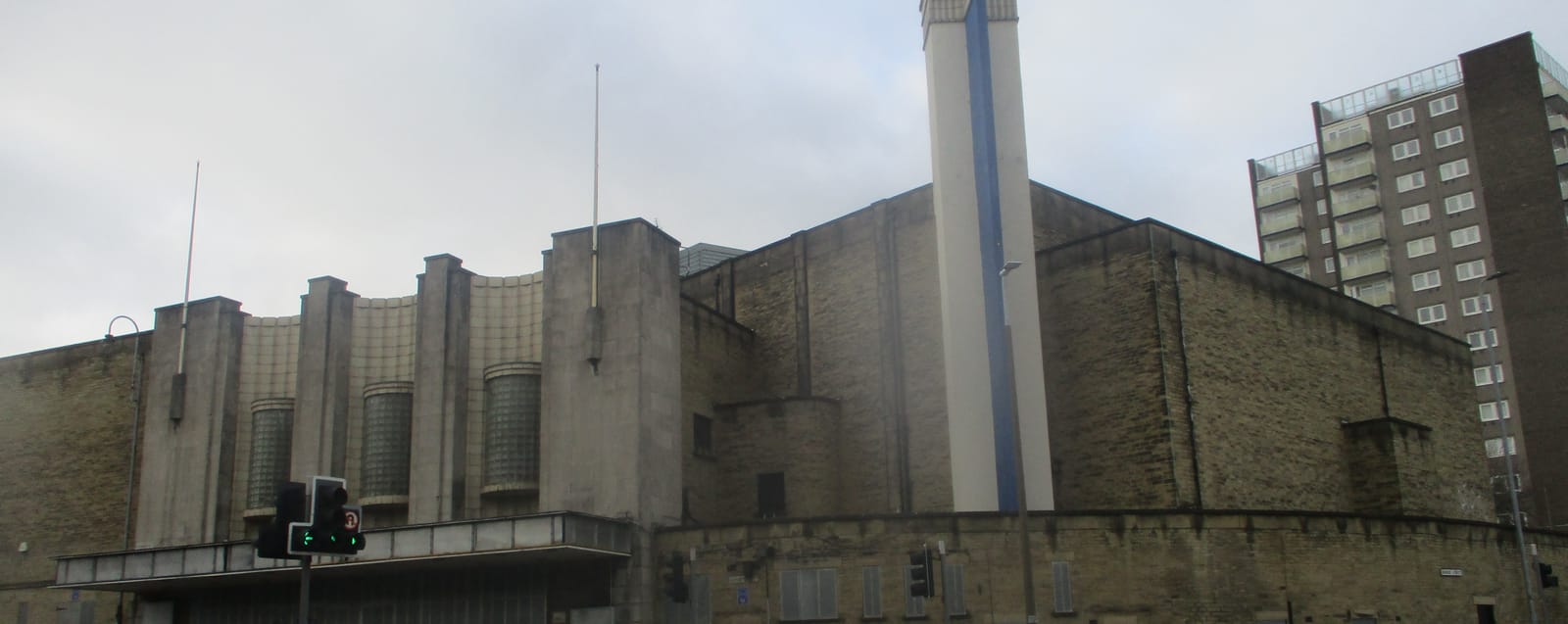
The timing of the 1960 Act was perfect for the cinema chains. Television was emptying the picture houses, and a large cinema with a stage and several hundred seats was ideal for bingo. Chains such as Granada, Rank and Mecca converted many of their cinemas into bingo halls through the 1960s and 1970s. That is why so many UK bingo halls sit behind grand art deco facades, like the former Mecca hall on Broad Street in Halifax shown above.
The most famous is the Granada Tooting in south London, a lavish cinema of 1931 with a Gothic interior by the designer Theodore Komisarjevsky. It became a bingo hall in the 1970s and is now Grade I listed, one of very few buildings of its kind with that status. You can see it on our home page. The conversions saved many cinema buildings that would otherwise have been demolished, and in several towns the bingo hall is still the grandest building on the high street.
Bingo halls became social centres, especially for older women, with regular sessions, cafés and a strong sense of community. The caller became a local personality, and the calls grew as each hall added its own jokes. It is the atmosphere that people still mean when they talk about going to the bingo.
Change and decline
From the 1990s the number of halls began to fall. Changing habits, competition from the National Lottery from 1994, and later the smoking ban, which came into force in Scotland in 2006 and in England in 2007, are all widely cited reasons. Many smaller halls closed, and large operators merged and rebranded. In 2018, the former Gala halls, including the Granada Tooting, were rebranded as Buzz Bingo. Mecca remains the other major name in British hall bingo. Some halls have reinvented themselves with food, entertainment and electronic games; bingo nights in bars and clubs, played for laughs, have brought a younger crowd to the game.
Online bingo
Online bingo began in the late 1990s and grew rapidly through the 2000s, especially in Britain, where it built on the familiar 90-ball game and the calls. Online rooms replaced the machine with a random number generator and the hall with a chat room and a host. Online rooms now sit alongside the halls rather than replacing them. Online bingo is regulated gambling, licensed by the Gambling Commission, and for over-18s only; our bingo odds page explains how the random draw works.
Where the calls came from
The calls are a history lesson in themselves. The forces gave the game its wartime slang. The music hall gave it names like Harry Tate for 8. The radio and television of the 1950s gave PC 49 and Sunset Strip. The calls also preserve old money, such as half a crown for 26, and old ages, such as key of the door for 21. Every one of them, with its story, is on our bingo calls page.
The history of bingo in eleven dates
| When | What happened |
|---|---|
| c. 1530 | The Italian state lottery, Lo Giuoco del Lotto d'Italia, is usually given as the starting point of the family of games bingo belongs to. |
| 1700s | Lotto is played in France on cards with three rows of nine squares, the same shape as a UK ticket today. |
| 1800s | Lotto games are used in Germany and elsewhere to teach children spelling, history and times tables. |
| Early 1900s | Housey-housey is played in the British army and navy, and continues through both world wars. |
| 1929 | Edwin S. Lowe, a New York toy salesman, sees "beano" at a carnival and markets it as bingo. |
| 1960 | The Betting and Gaming Act allows commercial bingo in Britain; it comes into force in 1961. |
| 1960s | Cinema chains convert picture palaces into bingo halls across the UK. |
| 1968 | The Gaming Act brings bingo clubs under closer regulation and licensing. |
| 2005 | The Gambling Act 2005 creates the modern framework; the Gambling Commission takes over in 2007. |
| 2007 | The smoking ban in England follows Scotland's of 2006, and is widely blamed for hall closures. |
| 2018 | The Gala halls are rebranded as Buzz Bingo, including the Granada Tooting. |