The UK bingo terms glossary, A to Z
Bingo terminology comes from three places. Some of it is simply the names of the parts of the game, such as ticket, line and full house. Some is hall slang from the post-war boom, when the game moved from forces huts into converted cinemas. And some is newer online shorthand. The meanings in this glossary are the ones used in the UK; where the American word is different, we say so.
#
- 1TG, 2TG
- Online shorthand for one to go and two to go: how many numbers a ticket still needs. Rooms often sort tickets by it.
B
- Bingo calls
- The traditional nicknames for the numbers, such as "legs eleven" for 11. Also called bingo lingo. See our list of all 90 bingo calls.
- Blackout
- American for covering every square on a 75-ball card. Also called a coverall. The British equivalent is the full house.
- Blind
- Said by some callers before a number ending in zero, as in "blind thirty". It marks that the number has only one digit that matters.
- Blower
- The air-blower machine used in most UK halls: a fan keeps the balls moving inside a clear dome and lifts one at a time into view for the caller.
- Book
- The set of tickets you buy for a session in a hall, one page per game, usually each page in a different colour.
C
- Caller
- The person who runs the game, draws the numbers and reads them out, then checks claims. You can call a game at home with our bingo caller.
- Card
- The American word for what British players call a ticket. In the UK "card" is also used loosely for any bingo grid.
- Checker
- The member of hall staff who comes to your seat when you claim and reads your numbers back to the caller. Also called a floor walker or floor staff.
- Claim
- Calling out that you have won. It must be made before the next number is drawn, and it is checked before the prize is paid.
D
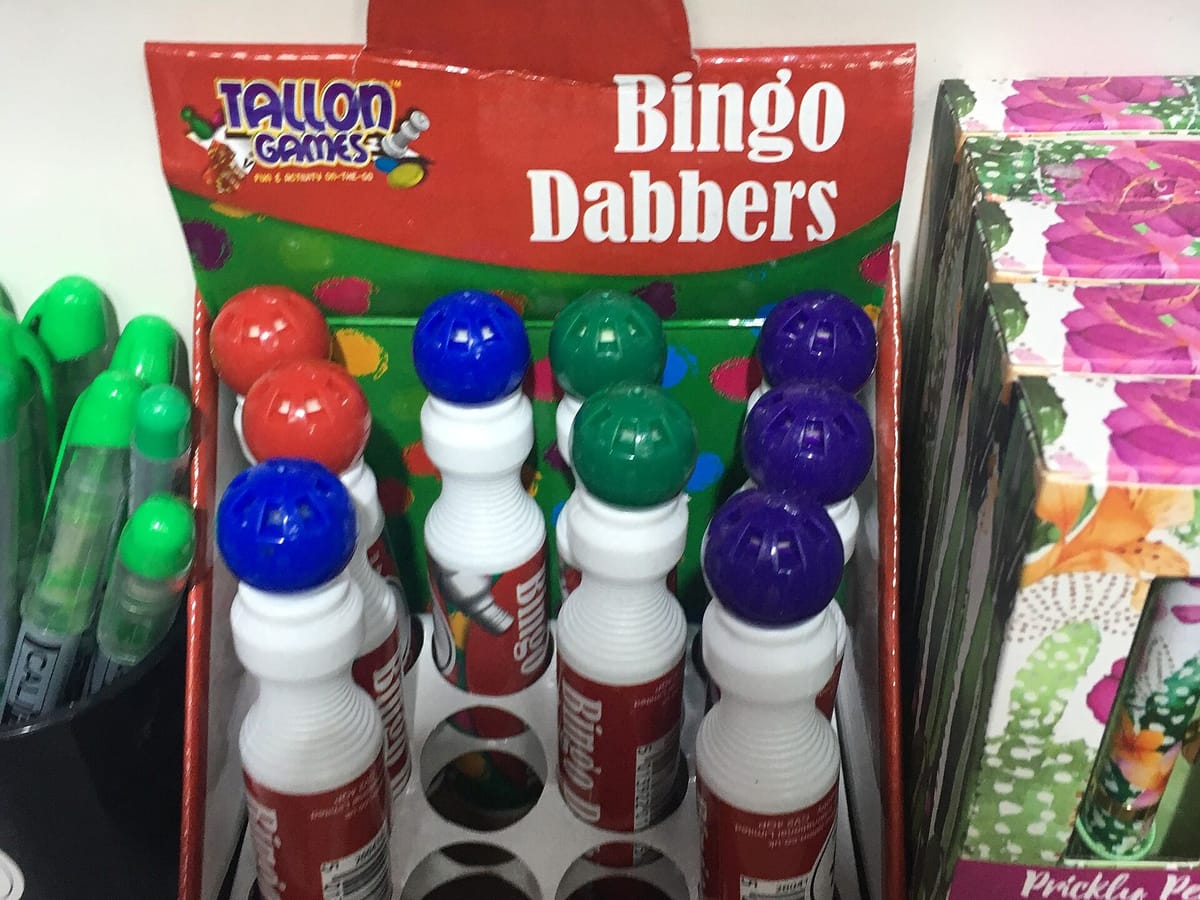
- Dabber
- A bottle-shaped felt-tip marker that leaves a round blot of ink. Also spelled dauber. The usual way to mark paper tickets in a hall.
E
- Early bird
- A game played before the main session starts, for players who arrive early.
- Eyes down
- The caller's signal that a game is starting. It means stop talking and look at your tickets. It is also the name of our daily bingo puzzle.
F
- False call
- A claim that turns out to be wrong. The game resumes. Also called a bogey or bogus call.
- Four corners
- A win using only the four corner numbers of a ticket or card. A pattern in 75-ball, and an occasional extra prize in 90-ball.
- Free space
- The centre square of a 75-ball card, counted as marked from the start. UK tickets have none.
- Full house
- All fifteen numbers on one 90-ball ticket marked. The main prize of every game, and the one that ends it.
H
- House
- Short for full house, and what you shout when you have one. From housey-housey, the older name of the game.
- Housey-housey
- The name of the game in the British armed forces before "bingo" caught on. Often shortened to housey.
- Housie
- The usual name for 90-ball bingo in Australia, New Zealand and India.
K
- Kelly's eye
- The call for number 1, usually traced to the eye slit in the armour of the outlaw Ned Kelly.
L
- Line
- In 90-ball, one complete row of five numbers on a ticket, and the first prize of the game. In 75-ball, any complete row, column or diagonal.
- Lingo
- Bingo lingo: the whole language of the calls, their rhymes and the responses the hall shouts back.
N
- National game
- A game played at the same time across many halls, linked to share a single, larger prize.
O
- On one
- Needing just one more number to win. Also said as "waiting" or "sweating". Online, "1TG" means one to go.
P
- Pattern
- The shape that wins a 75-ball game, announced before it starts: a line, the four corners, an X, a blackout and many more.
R
- RNG
- Random number generator: the software that draws numbers in online bingo in place of a ball machine.
S
- Session
- A block of games in a hall, typically in the afternoon or the evening, with a break in the middle.
- Sleeper
- A player who had a winning ticket but did not claim in time, so the win was lost.
- Snowball
- A jackpot for a full house within a set number of calls. If nobody wins it, it grows, or snowballs, for the next session.
- Split
- What happens when two or more players win the same prize on the same number: the prize is shared equally.
- Strip
- Six 90-ball tickets printed together that hold every number from 1 to 90 exactly once. See bingo tickets.
T
- Ticket
- The British name for a 90-ball grid: three rows, nine columns, fifteen numbers.
- Tombola
- The Italian game that bingo descends from, and a name for 90-ball in parts of Europe. In Britain also a raffle drum at fêtes.
- Top of the shop
- The call for 90, the highest number in the British game.
- Two lines
- Two complete rows on the same 90-ball ticket, the second prize of the game.
Full house and the other wins: their meanings
The words for winning are the ones that matter most, because getting them wrong costs you a prize, and what is a full house in bingo is the question new players ask first. In UK 90-ball there are three wins per game, always in this order. A line is one complete row of five numbers on a ticket. Two lines means two complete rows on the same ticket. The full house is all fifteen numbers on one ticket.
So, what is a full house in bingo? It is the last and largest prize in every 90-ball game, and it is the moment that people mean when they talk about "winning at bingo". The word comes from housey-housey, the forces name for the game, and many players still just shout "house". In 75-ball, the American game, the equivalent of a full house is a blackout or coverall, and there are other patterns in between; they are explained on our 75 ball bingo page.
Some halls add extra wins with their own names: the four corners, for the first and last number on the top and bottom rows; a snowball for a full house inside a set number of calls; or a national game shared with other halls. They are house rules rather than part of the game itself, and the caller will always explain them before they start.
Bingo terms for the numbers themselves
The largest group of bingo terms is the calls: the traditional nicknames for each number, from Kelly's eye for 1 to top of the shop for 90. They are the most distinctive part of UK bingo terminology and they have a whole page of their own, with the meaning and origin of all 90, on our bingo calls page. A few terms describe how numbers are called rather than what they are called: "blind" before a number ending in zero, "all the" for doubles such as "all the fours", and "on its own" for a single digit.
Online bingo terminology
Online rooms added their own vocabulary, most of it from the chat. The chat host or chat moderator runs the conversation and sometimes small side games. Tickets are sorted by 1TG, 2TG and so on, the number still needed. Auto-dab means the software marks your tickets for you, and the RNG is the random number generator that draws the numbers. Players type short greetings like "gl" for good luck and "wd" for well done when someone wins. In Great Britain, online bingo is regulated gambling and for over-18s only.