Bingo odds: your chances are your share of the tickets
Here is the single most useful fact about bingo odds. In a fair game, every ticket has exactly the same chance of winning each prize. So your chance of winning is simply the number of tickets you hold divided by the number of tickets in play. Hold 6 tickets in a game of 300 and your chance of the full house is 6 in 300, or 2%, which is 1 in 50. Your chances of the line and of two lines are the same 2%.
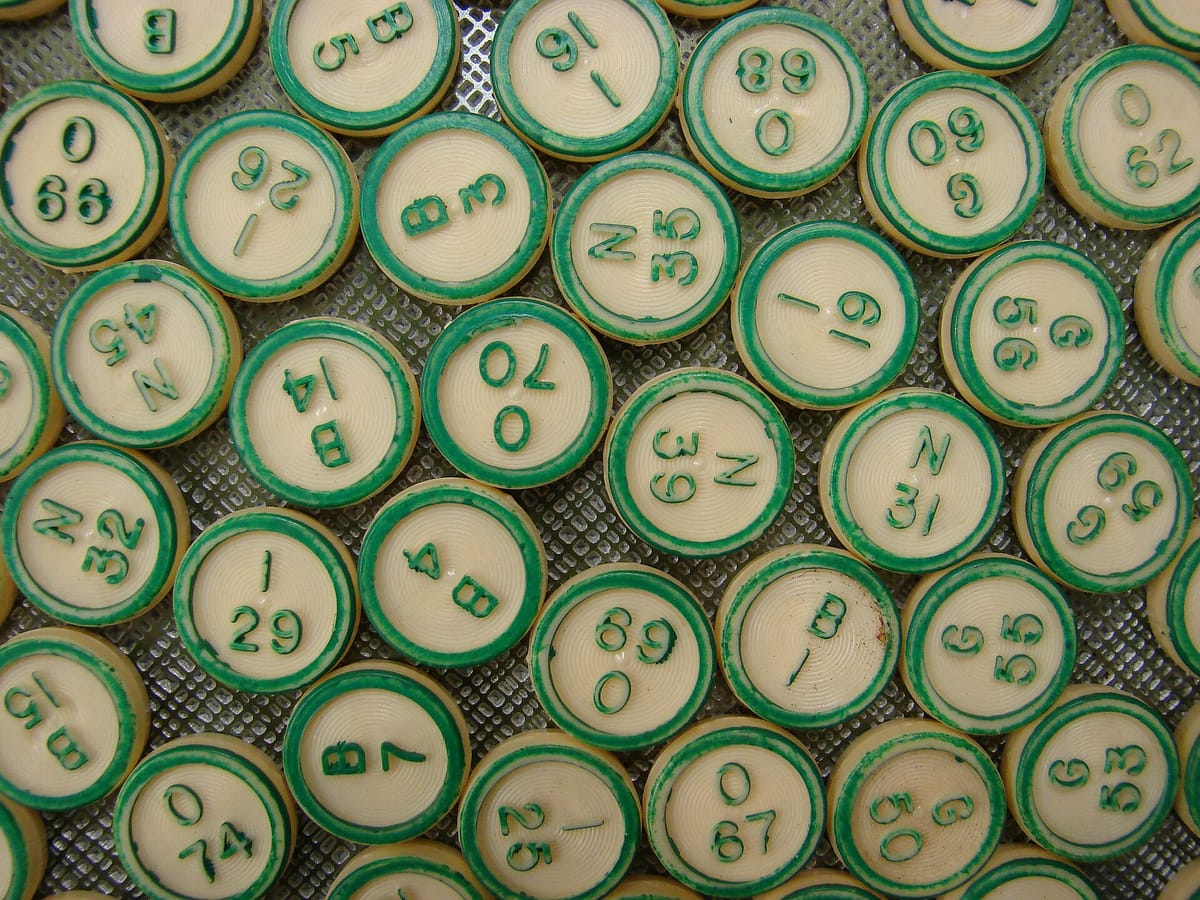
That is also the whole answer to the question of how to improve your odds of winning bingo. You can hold more tickets, or you can play in games with fewer tickets in total. Both change the ratio. Nothing else does. More tickets cost more, of course, and smaller games pay smaller prizes, so neither is a way of beating the game; it just changes the shape of what you are paying for.
Bingo odds work the same way online and in a hall. Two small adjustments. When two players complete the same prize on the same number, they share it, which slightly reduces what a win pays without changing how often you win. And a strip of six tickets is not six independent chances, because its tickets share no numbers; that affects how your wins cluster but not your overall share.
Why the draw is random and every ticket is equal
Two things make every ticket equal. The first is the random draw. Every one of the 90 numbers is equally likely to be drawn next, whether it comes from a ball machine or a random number generator, and nothing that has happened so far changes that. The second is the design of the tickets. Every UK ticket has fifteen numbers, five to a row, drawn from the same ranges, so no ticket is built to be luckier. Our page on bingo tickets explains the rules.
A consequence that surprises people is that no combination of numbers is more likely than another. A ticket full of low numbers, or one with numbers that "have not come up for weeks", has the same probability as any other. Random draws have no memory.
The probability of a full house on one ticket
For a single ticket, the probability of a full house after a given number of calls can be worked out exactly. It is the chance that all fifteen of its numbers are among the numbers called so far. The curve is steep: almost nothing happens for the first half of the game, and then the chance rises sharply in the last twenty calls.
| After this many calls | Chance of a full house |
|---|---|
| 45 calls | 0.00075% |
| 55 calls | 0.026% |
| 60 calls | 0.12% |
| 65 calls | 0.45% |
| 70 calls | 1.6% |
| 75 calls | 5.0% |
| 80 calls | 14.5% |
| 85 calls | 39.3% |
| 88 calls | 69.3% |
| 89 calls | 83.3% |
| 90 calls | 100% |
On average one ticket needs about 85 calls to fill completely. That is why a family game with a handful of tickets often goes into the eighties, and it is why a single ticket very rarely wins a jackpot for an early full house. For a line, the numbers are kinder: the chance that one particular row is complete is higher, and a ticket has three rows. One ticket has about a 1% chance of a line within 30 calls, 4.4% within 40 calls and 13.9% within 50.
What happens with many tickets in play
In a real game, the question is not when your ticket fills, but when anyone's does. With hundreds of tickets in play, one of them is likely to complete much earlier than the average ticket. We simulated large numbers of 90-ball games at different sizes to find the typical call on which each prize is won:
| Tickets in play | One line | Two lines | Full house |
|---|---|---|---|
| 6 | 47 | 67 | 79 |
| 60 | 31 | 54 | 69 |
| 300 | 24 | 47 | 63 |
| 1,200 | 19 | 41 | 58 |
In a large game of 1,200 tickets, the full house usually goes somewhere between the 45th and 65th call. Notice that the game gets shorter as it gets bigger, but not by much: multiplying the tickets by 200 takes only about 21 calls off the full house. The rules of the stages are on our 90 ball bingo page.
Jackpots and snowballs
Many games offer a bonus for a full house within a set number of calls. The probability is low, and it falls very fast as the limit drops. For a single ticket, a full house within 45 calls has a chance of about 1 in 130,000. Even in a large game of 1,200 tickets, someone completes that early only in roughly 1 game in 100. Within 50 calls it happens in roughly 1 large game in 17. That is why snowball jackpots can grow for weeks, and why they should be seen as a rare extra, not a reason to play.
Bingo tips that are myths
Most bingo tips are harmless, but none of them changes the odds. Here are the common ones and what the maths says:
- "Pick tickets with a spread of numbers." Every UK ticket already has a spread, by the column rule, and every ticket has the same chance.
- "Numbers that have not come up are due." Random draws have no memory. A number that has not appeared for ten games is exactly as likely as any other.
- "Sit in a lucky seat." Seats do not affect the draw.
- "Play at quiet times." This one is real, but only because fewer tickets are in play; the prizes are usually smaller for the same reason.
- "Buy more tickets." It raises your chance, in proportion to the cost. It does not improve the value of each ticket.
The only tip that genuinely helps is to watch your tickets and claim on time, so you never lose a win you have. The traditional bingo calls help there too, because they make each number hard to mishear.
Is online bingo rigged?
Online bingo replaces the ball machine with a random number generator. For operators licensed by the Gambling Commission, those generators must meet technical standards and be tested by approved independent testing houses, and the operator cannot choose which numbers are drawn or who wins. On a licensed site, then, the answer to "is online bingo rigged" is no: the draw is random, and the ticket-share rule above applies exactly as in a hall.
Two cautions. First, unlicensed sites are outside that system, so check for a valid Gambling Commission licence before trusting any site. Second, "not rigged" does not mean "good odds". The operator takes a share of the ticket money, so on average players get back less than they pay in. Whether online or in a hall, bingo is best treated as paid entertainment with a budget you set in advance. If it stops being fun, free help is available from BeGambleAware. This site does not run games or recommend operators.