How to run a game with the free bingo caller 1-90
This bingo caller 1-90 does the job of the ball machine and the caller's board at once. You are the caller: you decide when each number comes out and what you say about it. A game takes five steps:
- Hand out tickets. Each player needs a UK 90-ball ticket. Print valid strips from our bingo tickets generator; a strip of six covers every number, so you can deal up to six players from one page.
- Agree the prizes. Decide what the one line, two lines and full house are worth, even if it is only chocolate. Everyone should know before "eyes down".
- Start calling. Press Call a number and the bingo caller 1-90 draws the first ball. Read out the nickname and the number, and give the room a few seconds before the next one. If you would rather not press, set auto-call to every 5 or 10 seconds.
- Stop for claims. When someone calls "house" or "line", pause auto-call and ask them to read out their numbers. Check each one against the board below the stage, where every number already called is lit.
- Carry on or reset. After the line and two lines, keep going to the full house. Then press New game, and the bingo number generator puts all 90 numbers back.
The last five numbers are listed beside the stage, which helps if someone missed a call. The count shows how many of the 90 are out, which is the question every player asks at some point in a long game.
Calling the nicknames online: host mode
With Show the nickname switched on, the stage shows the call for each number as it appears: Kelly's eye for 1, two little ducks for 22, top of the shop for 90. The same list of names and origins appears on our bingo calls page, so the online bingo caller and the reference always agree. It means anyone can host a game in proper hall style without having learned the calls.
Switch the nickname off if you want to play a harder game, or if you are practising calling from memory. You can also use it the other way round for a lingo quiz: read out only the nickname, and let the players work out the number before they can mark it.
Read it aloud uses your device's built-in speech voice, set to British English where one is available. It is off by default, so the page never makes a noise you did not ask for, and it stops if you switch to another tab.
How the bingo number generator draws the numbers
A fair draw has two properties. Every number must come out exactly once, and at every point, every remaining number must be equally likely to come next. This bingo number generator does it the way a ball machine does. When a game starts, all 90 numbers go into the pool. Each press takes one out at random, using the random source your browser provides for cryptography, and it is gone from the pool until the next game. The draw uses a method that avoids the small bias a naive shortcut would give to the lower numbers, so no number is favoured, even by a fraction.
Nothing is decided in advance and nothing is sent anywhere. The draw happens in your browser, which means the page works offline once it has loaded, and neither we nor anyone else can see or influence the numbers. If you want to read more about why every ticket then has the same chance, the maths is on our bingo odds page.
Using it on a TV, a projector or a video call
For a room of players, put the page on the biggest screen you have. Most smart TVs and games consoles have a browser; otherwise cast a laptop or phone screen to the television. The big ball and the nickname are sized to be read from across a room, and the board lets players check their own tickets without asking.
For an online game over Zoom, Teams or a family video call, share your screen with this page and turn read-aloud on, or just read the numbers yourself. Each player needs their own ticket: send them a printed or PDF strip beforehand. There is more on virtual games on our party bingo page. For picture, word or 75-ball games, the bingo card generator has its own caller for any list.
Before there were apps: the bingo machine
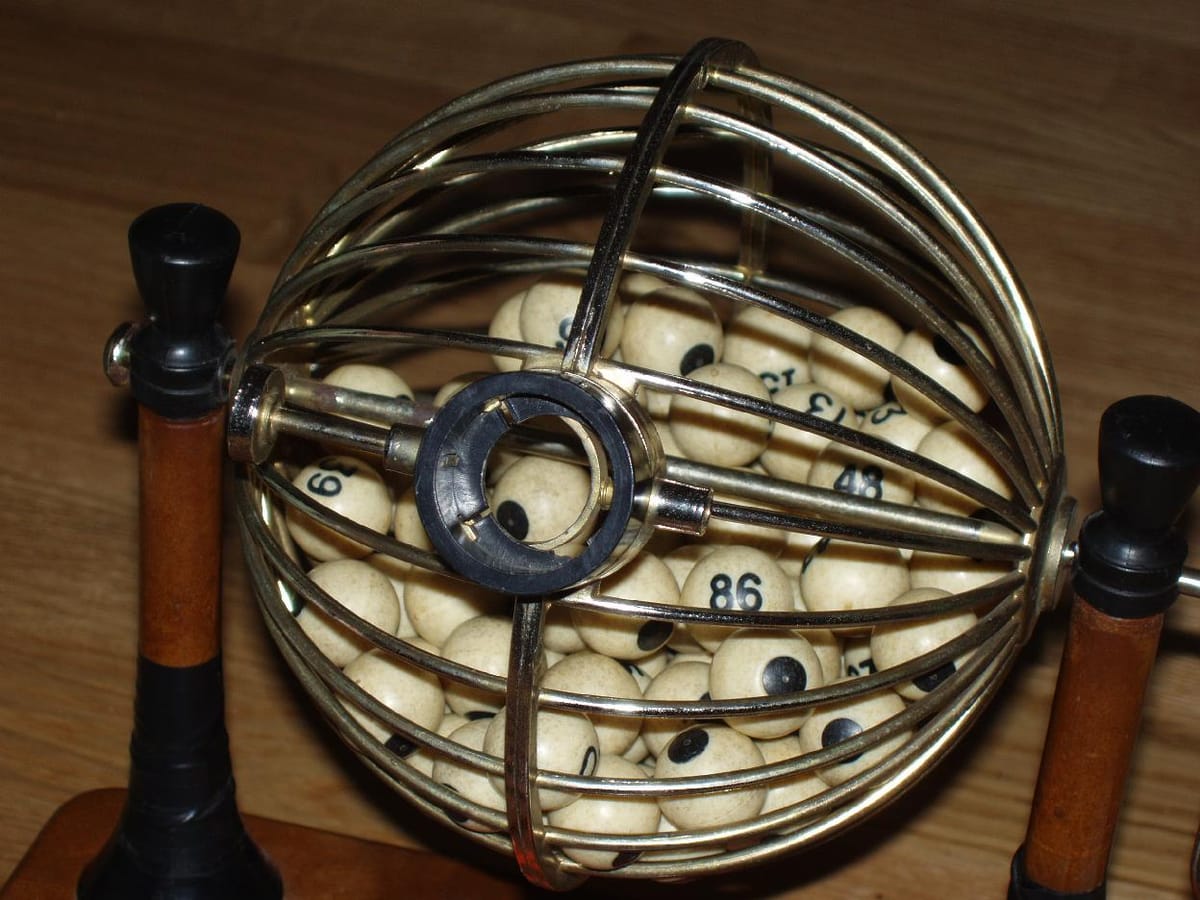
For most of the game's history the numbers came out of a cage or a bag. Forces games of housey-housey used numbered counters drawn from a bag or a tin, and many church halls and holiday camps used a hand-cranked wire cage of wooden or plastic balls. As bingo became big business in the 1960s, halls moved to air-blower machines, where a fan keeps the balls in the air inside a clear dome and one at a time is lifted into a tube for the caller. It is a draw that everyone in the room can see, which is exactly why it was adopted.

Electronic boards followed, lighting each number as it was called so the whole hall could check. Many modern halls now combine a blower with a screen system, and some use electronic random number generators with the balls kept for show. Online bingo removes the balls completely. The principle has not changed: every number once, in an order nobody knows beforehand.
90-ball and 75-ball calling
This caller is built for the British 90-ball game, with the board laid out in the same nine column ranges as a UK ticket. If you are playing the American 75-ball game, which uses letters with its numbers, such as B-7 or O-72, the draw is different, and so are the cards. Our 75 ball bingo page explains the differences.
Hosting tips from the halls
- Keep a steady rhythm. Around one number every five seconds suits most home games. Beginners and children like ten.
- Say the number twice. Nickname, then number. It prevents mishearing and is the traditional way.
- Never call the next number during a claim. It is the one rule that avoids arguments.
- Check out loud. Read the claimant's numbers back one by one while everyone listens. It builds trust and the suspense is part of the fun.
- Plan several short games rather than one long one, and change the prizes between them.