The bingo ticket generator
Press the button to deal a fresh strip of six 90-ball tickets. Every strip is checked before it is shown: six tickets, fifteen numbers on each, five on every row, every column in its range, and all 90 numbers used exactly once. Print sends only the strip to your printer, not the rest of the page.
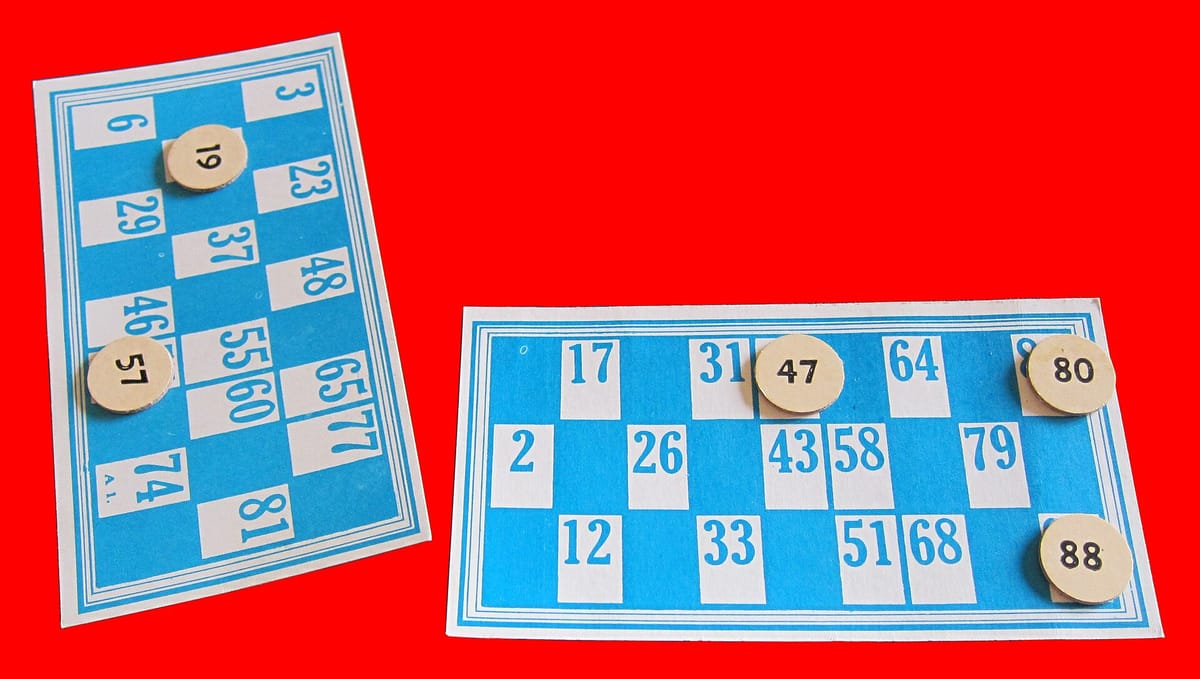
The generator runs in your browser and never sends anything anywhere. Each press is a new random strip, so you can print as many different bingo tickets as you have players. For a big group, print several strips; tickets from different strips can share numbers, which is normal in a hall.
What is on a UK 90-ball bingo ticket
The ticket is a grid of 27 squares: nine columns and three rows. Exactly fifteen squares carry numbers and the other twelve are left blank. The rules for where those numbers go are strict, and they are the same on every 90-ball ticket printed in Britain:
- Five numbers on every row. Never four, never six. That is why a single line is always five numbers.
- At least one number in every column, and never more than three, since there are only three rows.
- Each column has its own range. The first holds 1 to 9, the second 10 to 19, and so on up to 80 to 90 in the ninth.
- Numbers run downwards in order. Inside a column, the smallest number is at the top.
The five-per-row rule means that every row is a fair race: no row can be won quicker because it has fewer numbers. The column rule means that you can find any called number in a glance. When the caller says 64, only the seventh column can hold it.
Why bingo tickets come in strips of six
This is the part that most explanations miss. A UK strip is six tickets that, between them, hold every number from 1 to 90 exactly once. Six tickets times fifteen numbers is ninety, and nothing is repeated or left out. It is a small but clever piece of design.
The consequence is that if you play a full strip, every number the caller draws is on one of your tickets. You will mark something on every call, which makes the game feel busy, and you are guaranteed to be in the running for every prize. What it does not do is guarantee a win: other players have their own strips, and a win depends on completing a whole row or ticket before anyone else does. Our bingo odds page works out what a strip does and does not change.
Building a strip that obeys every rule at once is harder than it looks, because the column counts have to add up across all six tickets. The first column has only nine numbers to share between six tickets, and the last column has eleven, so some tickets get one number in a column and others two or three. Our generator places the numbers column by column, then arranges them so that each row lands on exactly five, and then checks the result.
The column rule, and why the last column has eleven
The ranges are almost, but not quite, even. The first column runs from 1 to 9, which is only nine numbers, because there is no 0. The ninth column runs from 80 to 90, which is eleven, because 90 has to go somewhere. Every column in between holds ten. That adds up to 9 + 70 + 11 = 90.
On a strip this matters. The nine numbers of the first column are spread across six tickets, so every ticket gets at least one and some get two or three: a common split is three tickets with two and three with one. The eleven numbers of the last column are shared the same way, for example five tickets with two and one with a single number. It is why the last column of a ticket looks busier than the first, and why experienced players glance to the right when they hear a number in the eighties.
Printable bingo cards: making your own
For a home game, printable bingo cards from the generator are the easiest option. Print on plain A4, cut the strip into six tickets and hand one or more to each player. Players can mark with a pen, or with coins or counters if you want to reuse the tickets. If you want printed tickets to last, slip them into clear plastic sleeves and mark with a whiteboard pen.
Blank bingo cards are useful for other kinds of game. A blank 90-ball ticket lets players write in their own numbers, which works for teaching the column rule to children. For picture, word or human bingo you want a blank square grid instead, usually five by five; our bingo card generator prints them in any size, and the party bingo page has ideas for filling one. If you make blank bingo cards yourself, keep the squares big enough for a child's handwriting.
Do not simply fill a grid with fifteen random numbers from 1 to 90. It will look like a ticket, but rows may have the wrong count and some columns may be empty, and the game becomes unfair in small ways that players notice. The printable strips here follow all the rules for you.
Books and strips in a bingo hall
In a UK hall you buy your tickets as a book for the session. A book holds one strip per game, each page often in a different colour so that the caller can say "the pink ticket" or "the blue game" and everyone knows which page to use. Books come in sizes by the number of tickets per game, and many halls sell extra books or single games for players who want more. Specials, such as the session's big full house game, sometimes have their own ticket.
Players mark tickets with a dabber, a felt-tip bottle that leaves a round splash of ink, although many regulars prefer a pen for speed. Increasingly, halls also sell electronic tickets on handheld terminals that mark themselves. Online rooms show tickets on screen and usually sort them so that the ticket closest to winning is on top.